








GAA

Share
Published 20:27 19 Nov 2017 GMT
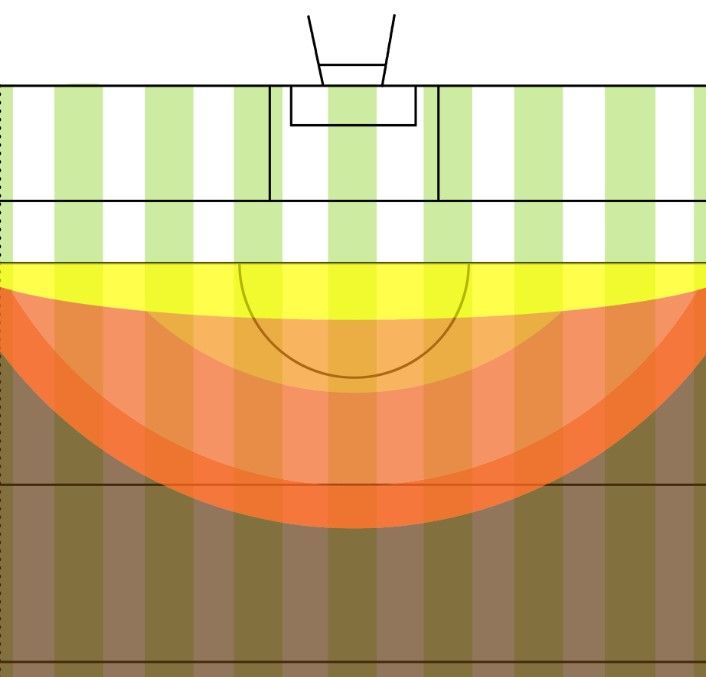 The central orange zone is always categorised as the half back line, the lighter orange is categorised as half back line (not full back line) if it takes out three opponents or more, and the darker orange is categorised as half back line (not midfield) if it doesn’t take out five opponents or more.
With over two thousand kick-outs of analysis from over forty different club and county teams, I’ve found just one side to have made a profit from this kind of kick-out, and that has only been as of their 2017 form – Stephen Cluxton and Dublin.
The problems with kicking to the half back line are multiple, but first let’s have a brief look at kick-outs to the full back line to give a context.
The simplest and most effective kick-out strategy across the board has been the quick kick-out to the full back line. Typically, the keeper can hit his target easily and his team can catch the opposition off guard.
Slow kick-outs to the full back line are far less profitable. If the kick isn’t hit within 9.5 seconds of the ball going dead, you can expect to have to break down thirteen, fourteen, or fifteen of the opposition. It’s not an easy thing to do.
The central orange zone is always categorised as the half back line, the lighter orange is categorised as half back line (not full back line) if it takes out three opponents or more, and the darker orange is categorised as half back line (not midfield) if it doesn’t take out five opponents or more.
With over two thousand kick-outs of analysis from over forty different club and county teams, I’ve found just one side to have made a profit from this kind of kick-out, and that has only been as of their 2017 form – Stephen Cluxton and Dublin.
The problems with kicking to the half back line are multiple, but first let’s have a brief look at kick-outs to the full back line to give a context.
The simplest and most effective kick-out strategy across the board has been the quick kick-out to the full back line. Typically, the keeper can hit his target easily and his team can catch the opposition off guard.
Slow kick-outs to the full back line are far less profitable. If the kick isn’t hit within 9.5 seconds of the ball going dead, you can expect to have to break down thirteen, fourteen, or fifteen of the opposition. It’s not an easy thing to do.
My figures have shown that only a handful of club teams actually score more off their initial possession than they concede off the first turnover in this situation.Alluding to pure footballing quality, Kerry were always an outlier at inter-county level in this regard, but as management teams and attacking structures have become more savvy, most of the top county sides have begun to make a profit off the short kick-out to the full back line, even if it’s not hit inside the magic 9.5 seconds. Starting to see the problem with kick-outs hit to the half back line quickly (11.5 seconds is the magic number when it comes to kicks to the half back line). At least when you go short, but not quickly, to the full back line, the keeper is typically hitting an easy target, close to him. Also, if the receiver is under any pressure when he grasps the ball, there’s the easy “out” of a hand-pass back to the keeper, where possession maintenance should be straight forward.
Even at that, most sides concede more off the first turnover than they do off the initial possession.Going to the half back line, however, unless it’s done quickly, there are two added negative dynamics. Firstly, the target is far more difficult to hit. It’s classic hunter-gatherer psychology from the keeper. They can see the player running forty odd yards away and think “I can hit him”. They know they can hit him. But I beg the question – with what percentage of accuracy can you expect to hit him? Most keepers, if asked, would probably tell you that they have over a ninety percent chance of hitting their target. Unless they’re top class strikers of the ball, they’re over-estimating their ability. Typically, over thirty percent of these efforts go over the side-line, are won by the opposition or else the opposition force a free or turnover within two seconds of the receiver catching the ball.

GAA

GAA
GAA
GAA
Kerry GAA boss calls out AFL clubs over ‘sneaky’ gift to players
He is not happy! The president of the GAA, Jarlath Burns, is set for big talks with AFL representatives before the end of the month, in their continued attempts to curb the flow of players to Australia. There are currently 14 Irish players contracted to AFL clubs, with these including some of the most talented […]
GAA
22h
Galway give timeline for new manager as Jim Gavin out of running
They will be making a decision soon! Jim Gavin appears to be out of the running for the Galway manager job, following the departure of Pádraic Joyce. A six-time All-Ireland winning boss with Dublin, Gavin was seen as a strong contender and had held talks with Galway GAA officials. But despite this, and the fact […]
GAA
2 days ago
An in-depth ‘Football Manager’ game is coming to the GAA this year
GAA