


Football

Share
Published 21:38 30 Dec 2014 GMT
Explore more on these topics:
 What is in no doubt whatsoever though is Keane's position as a lightning rod for attention. O'Neill, while at times appears tetchy at being constantly asked about his deputy, evidently feels it is worth the cost, possibly because it has distracted from some of the side's failings.
The manager would no doubt immediately dispute this. Fans would have just cause to cite Ireland's result against Germany - the most an Irish fan has had to celebrate in years - as evidence for O'Neill's positive influence on the side.
However, Ireland's performance in the Scotland loss points to a number of pressing concerns. The team are essentially in a mini-group with Poland and Scotland. Without being overly presumptuous, the mighty German machine will spark into life next year and bulldoze their way to Euro 2016.
Every team will defeat Gibraltar, and, barring an upset, Georgia. This leaves three teams fighting for two spots, one of which being a play-off place. Currently Ireland are trailing and appear the weakest.
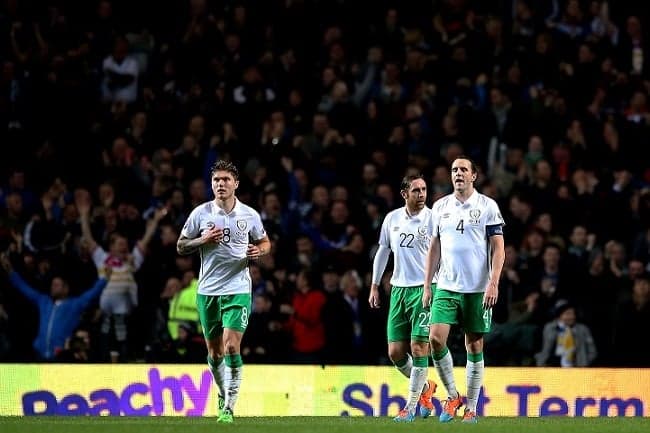
Before October's tie against Ireland, Scotland manager Gordon Strachan said he and his counterpart were 'old-fashioned'. Ireland's tactics during the game seemed archaic. O'Neill opted for a 4-4-2 formation, with Shane Long and Jonathan Walters up front, dropping main goal threat Robbie Keane to the bench, and leaving Ireland's midfield outnumbered.
Charlie Mulgrew was made to look like some highland Xavi as Ireland struggled to pick up the roaming Steven Naismith and Shaun Maloney.
Granted the Irish team were weakened by the absence of their first-choice central midfield pairing, James McCarthy and Glenn Whelan, but all the more reason to start a third player in the position. It had seemed the only reason to play such a formation was to accommodate Robbie Keane, yet the game was the first time in 13 years he had failed to start a qualifier when he was available.
Ireland's tactical frustrations were further compounded by the stunting of Seamus Coleman's attacking outlet and, at the times, the team were reminiscent of the worst elements of the Trapattoni years.
Hitting long-balls, yet not backing them up with pressure from midfield, cautious and overworked, Ireland fatally switched off as Scotland scored a well-executed goal. There is an argument to be made such a moment is a reflection of the work carried out by the respective management teams. If so, Ireland's came up short.
Anyone who has followed O'Neill's career will be familiar with his exuberant touchline antics and ability to raise the performances of his sides.
He was touted as one the game's brightest managers and had fantastic success with Celtic and Leicester City.
After returning to England his time with Aston Villa ended acrimoniously, before his career seemed to bottom out at Sunderland. The Germany result pointed to a potential managerial renaissance for O'Neill, but the Scotland game further emphasised the evidence present before he took the Ireland job. It seems as though the modern game has surpassed him.
What is in no doubt whatsoever though is Keane's position as a lightning rod for attention. O'Neill, while at times appears tetchy at being constantly asked about his deputy, evidently feels it is worth the cost, possibly because it has distracted from some of the side's failings.
The manager would no doubt immediately dispute this. Fans would have just cause to cite Ireland's result against Germany - the most an Irish fan has had to celebrate in years - as evidence for O'Neill's positive influence on the side.
However, Ireland's performance in the Scotland loss points to a number of pressing concerns. The team are essentially in a mini-group with Poland and Scotland. Without being overly presumptuous, the mighty German machine will spark into life next year and bulldoze their way to Euro 2016.
Every team will defeat Gibraltar, and, barring an upset, Georgia. This leaves three teams fighting for two spots, one of which being a play-off place. Currently Ireland are trailing and appear the weakest.
Before October's tie against Ireland, Scotland manager Gordon Strachan said he and his counterpart were 'old-fashioned'. Ireland's tactics during the game seemed archaic. O'Neill opted for a 4-4-2 formation, with Shane Long and Jonathan Walters up front, dropping main goal threat Robbie Keane to the bench, and leaving Ireland's midfield outnumbered.
Charlie Mulgrew was made to look like some highland Xavi as Ireland struggled to pick up the roaming Steven Naismith and Shaun Maloney.
Granted the Irish team were weakened by the absence of their first-choice central midfield pairing, James McCarthy and Glenn Whelan, but all the more reason to start a third player in the position. It had seemed the only reason to play such a formation was to accommodate Robbie Keane, yet the game was the first time in 13 years he had failed to start a qualifier when he was available.
Ireland's tactical frustrations were further compounded by the stunting of Seamus Coleman's attacking outlet and, at the times, the team were reminiscent of the worst elements of the Trapattoni years.
Hitting long-balls, yet not backing them up with pressure from midfield, cautious and overworked, Ireland fatally switched off as Scotland scored a well-executed goal. There is an argument to be made such a moment is a reflection of the work carried out by the respective management teams. If so, Ireland's came up short.
Anyone who has followed O'Neill's career will be familiar with his exuberant touchline antics and ability to raise the performances of his sides.
He was touted as one the game's brightest managers and had fantastic success with Celtic and Leicester City.
After returning to England his time with Aston Villa ended acrimoniously, before his career seemed to bottom out at Sunderland. The Germany result pointed to a potential managerial renaissance for O'Neill, but the Scotland game further emphasised the evidence present before he took the Ireland job. It seems as though the modern game has surpassed him.
 A sea change occurred in football in 2008. Spain's team of small, technically gifted players blazed a trail through the European Championship.
For years midfield had been deemed the land of the giants, physicality ruled as Patrick Vieira, Steven Gerrard and Roy Keane became the benchmark for the position.
Being a good footballer alone was not sufficient; players had to be lung-busting athletes. Spain broke the mould. When Pep Guardiola's Barcelona swept all before them in 2009, winning a historic treble of titles, it was confirmed; a new phase in football had begun.
Managers and teams were forced to adapt or perish as the dominance of both sides continued over the next five years. The current world champions are a hybrid of the two styles, combining German physicality with Spanish technique.
From Bayern Munich and Borussia Dortmund to Liverpool, Southampton and Everton in the Premier League, to the national teams of Chile, Italy and Japan, the influence of Barcelona and Spain remains omnipresent throughout world football.
Teams can be viewed as either being influenced by this change, or a reaction against it and most managers operating at the elite level, including international football, have adapted. Even if it is at a most basic level of not allowing the team's central midfield to be outnumbered in favour of a more physical presence up front.
However, judging by his final days with Sunderland, and Ireland's display against Scotland, O'Neill seems rooted to the past. He still seemingly favours the traditional 'British' style of 4-4-2, laced with physicality and effort and designed to hit a big-man up top early. O'Neill was, after all, Emile Heskey's manager for over six years of his career.
He approached the Scotland tie as though it was a traditional ‘British’ derby game and was tactically outwitted by Strachan. One could argue Ireland do not possess the players to play any other way. But they would probably say the same about Scotland. In a game of apparent equals, the Irish team were made to look distinctly the lesser of the two.
2015 will be the most pivotal year for the Irish national team in recent memory. There are crucial qualifiers against Poland and Scotland, as well as Germany and a high profile friendly with England. The prize at stake is qualification for Euro 2016, which has been expanded to 24 teams, almost half of the teams in Europe.
If Ireland fail to qualify, it will surely be the lowest ebb of the Irish team. Even Keane’s presence will not be able to deflect from that.
A sea change occurred in football in 2008. Spain's team of small, technically gifted players blazed a trail through the European Championship.
For years midfield had been deemed the land of the giants, physicality ruled as Patrick Vieira, Steven Gerrard and Roy Keane became the benchmark for the position.
Being a good footballer alone was not sufficient; players had to be lung-busting athletes. Spain broke the mould. When Pep Guardiola's Barcelona swept all before them in 2009, winning a historic treble of titles, it was confirmed; a new phase in football had begun.
Managers and teams were forced to adapt or perish as the dominance of both sides continued over the next five years. The current world champions are a hybrid of the two styles, combining German physicality with Spanish technique.
From Bayern Munich and Borussia Dortmund to Liverpool, Southampton and Everton in the Premier League, to the national teams of Chile, Italy and Japan, the influence of Barcelona and Spain remains omnipresent throughout world football.
Teams can be viewed as either being influenced by this change, or a reaction against it and most managers operating at the elite level, including international football, have adapted. Even if it is at a most basic level of not allowing the team's central midfield to be outnumbered in favour of a more physical presence up front.
However, judging by his final days with Sunderland, and Ireland's display against Scotland, O'Neill seems rooted to the past. He still seemingly favours the traditional 'British' style of 4-4-2, laced with physicality and effort and designed to hit a big-man up top early. O'Neill was, after all, Emile Heskey's manager for over six years of his career.
He approached the Scotland tie as though it was a traditional ‘British’ derby game and was tactically outwitted by Strachan. One could argue Ireland do not possess the players to play any other way. But they would probably say the same about Scotland. In a game of apparent equals, the Irish team were made to look distinctly the lesser of the two.
2015 will be the most pivotal year for the Irish national team in recent memory. There are crucial qualifiers against Poland and Scotland, as well as Germany and a high profile friendly with England. The prize at stake is qualification for Euro 2016, which has been expanded to 24 teams, almost half of the teams in Europe.
If Ireland fail to qualify, it will surely be the lowest ebb of the Irish team. Even Keane’s presence will not be able to deflect from that.
Football
Football
Football
Ireland legend Tony Cascarino talks Troy Parrott and Italia ’90
Tony Cascarino was speaking on behalf of Tonybet to mark the launch of their World Cup Card Collection campaign where Irish customers can win up to €100,000. The Irish football legend shared his insights on Troy Parrott and revealed stories from the Jack Charlton era. Cascarino appeared 88 times for Ireland, scoring 19 goals, none of which […]
Football
3 days ago
Quiz: Can you guess these iconic 2000’s World Cup players
Legends galore! The World Cup is thriving! The 2026 North-American edition of the tournament has kicked off and we all have World Cup fever. New legends are set to be born this summer, but can you name some iconic players from the noughties? Let us know how you get on and best of luck!
Football
4 days ago
Football
Quiz: Who said this about Roy Keane leaving Saipan?
Football